


ALBA-TCP rejects U.S. military deployment against Venezuela
The bloc categorically condemned the U.S. military deployment in the Caribbean, introducing destroyers, missile cruisers and nuclear submarines.
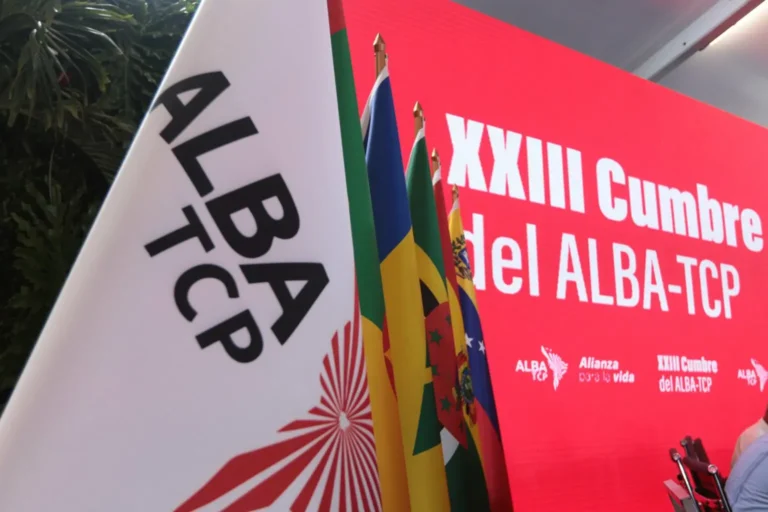
The Council rejected the report of the U.S. State Department that accuses Venezuela of being a drug producer and transit country, Photo: Cuban Foreign Ministry
September 25, 2025 Hour: 4:50 pm
🔗 Comparte este artículo
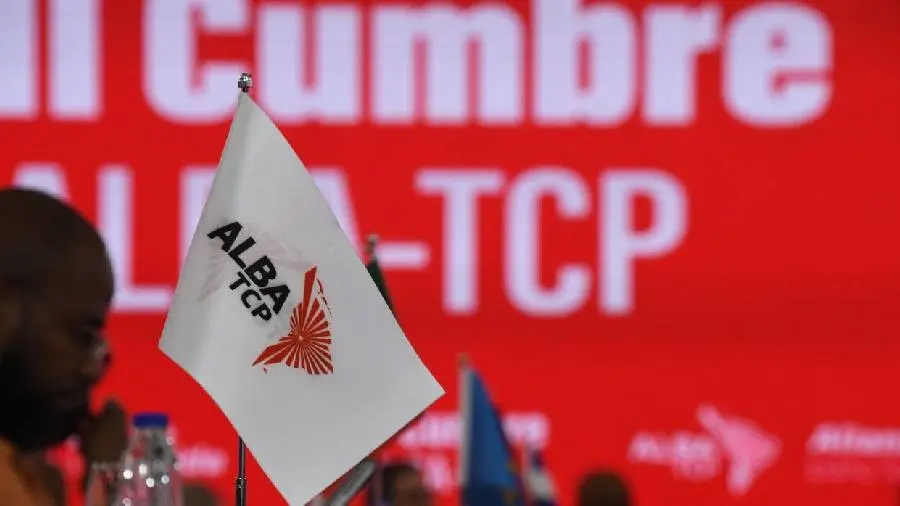
The member countries of the Bolivarian Alliance for the Peoples of Our America – People’s Trade Treaty (ALBA-TCP) reaffirmed this Thursday their commitment to the Proclamation of Latin America and the Caribbean as a Zone of Peace, within the framework of the XXVI Political Council, held in New York on the sidelines of the 80th session of the UN General Assembly.
RELATED:
Venezuela Accuses Guyana of Pushing a ‘False Narrative’ at UN Assembly
The meeting was attended by the Ministers of Foreign Affairs of Venezuela, Cuba, Bolivia, Nicaragua, Dominica, Antigua and Barbuda, Saint Vincent and the Grenadines, Saint Kitts and Nevis and Grenada, who highlighted the inspiration in the struggles of Simón Bolívar, José Martí, Augusto C. Sandino, as well as in the legacy of Hugo Chávez and Fidel Castro Ruz. a year after the centenary of his birth.
The bloc categorically condemned the U.S. military deployment in the Caribbean, introducing destroyers, missile cruisers and nuclear submarines. According to the document, these actions violate both the Proclamation of the Zone of Peace adopted by CELAC in 2014 and the Treaty of Tlatelolco, which establishes the denuclearization of Latin America and the Caribbean.
The foreign ministers denounced the incident with the fishing vessel “Carmen Rosa”, intercepted by the destroyer USS Jason Dunham (DDG-109) in Venezuelan waters, where nine fishermen were held for eight hours.
The ALBA-TCP described the action as a violation of maritime sovereignty, food security and human rights. They also condemned the extrajudicial executions in the Caribbean Sea, recognized by the U.S. government itself, and warned that Washington seeks to transform the region into a scenario of confrontation and militarization.
The Council rejected the U.S. State Department report accusing Venezuela of being a drug producer and transit country, noting that it contradicts reports from the U.N. Office on Drugs and Crime and the DEA, which do not place the country in that category.
They also expressed absolute support for President Nicolás Maduro Moros, denouncing the accusations against him as “unfounded and without legal support.”
The communiqué demanded the immediate cessation of unilateral coercive measures against Cuba, Nicaragua and Venezuela, and called for the lifting of the economic and financial blockade against Cuba, in addition to its exclusion from the U.S. list of alleged state sponsors of terrorism.
ALBA-TCP condemned what it called a genocide perpetrated by Israel in the Gaza Strip, demanding an immediate end to the occupation and reaffirming its support for the right of the Palestinian people to a sovereign state with East Jerusalem as its capital.
They also rejected Israeli attacks on Syria, Iran, Lebanon, Yemen and Qatar. The countries of the bloc called on CELAC to establish a common position against any external interference that threatens regional peace.
In addition, they announced the formation of a Special Mission of the ALBA-TCP to travel through Latin America and the Caribbean in defense of the Proclamation of the Zone of Peace. Finally, they convened a Great Conference for Peace in Latin America and the Caribbean, taking up the ideology of Simón Bolívar and the Amphictyonic Congress of Panama, with the aim of strengthening the unity and self-determination of the peoples of the region
Author: HGV
Source: Telesur